
Healthy Muslim Masculinity Requires a Different Understanding of God
We suggest as preliminary reading this address recently presented to the students of St Joseph's College, Hunters Hill by its Principal, Michael Blake: Dignity, Respect, Character.
Few issues generate as much confusion among Muslims today as masculinity. Across social media, mosque communities and popular religious discourse, Muslim men are often told that masculinity means leadership, authority, strength, dominance and control. The ideal Muslim man is imagined as decisive, emotionally restrained and firmly in charge of his household.
Of course, this issue is not present among Muslims alone.
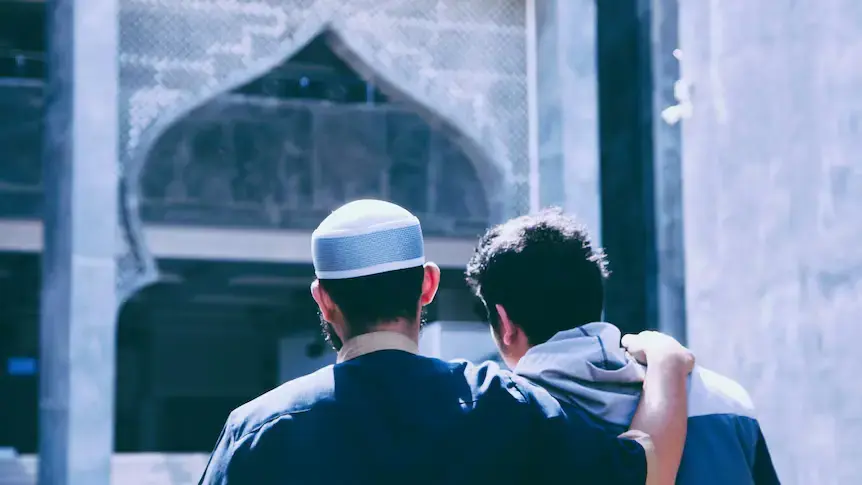
Yet many Muslim men are increasingly uncomfortable with this model. They sense that something is wrong when masculinity is defined primarily through power over others, and they recognise that such ideals often produce damaged relationships, emotional isolation and gender inequality.
What is less often recognised is that this “crisis of Muslim masculinity” is not merely social — it is also theological. Muslim masculinity requires a different understanding of God.
Much of traditional Muslim masculinity, I want to suggest, is rooted in a theological vision inherited from classical theism: a vision of reality structured by hierarchy, domination and what might be called a zero-sum understanding of power. If Muslim men are to cultivate healthier forms of masculinity in the twenty-first century, we need not only a new understanding of manhood but also a different understanding of divine power itself. This is why I believe process-relational Islam offers the most compelling path forward.
The shared logic of patriarchy and classical theism
Traditional constructions of masculinity and classical theistic images of God often mirror one another. Both tend to imagine reality as a chain of command: God rules over humanity; men rule over women; fathers rule over children; kings rule over subjects; religious scholars rule over ordinary believers.
Within this framework, power is understood largely as control. The more power one possesses, the more one can impose one’s will on others, so power becomes a scarce commodity: if one person gains authority, another loses it. Someone commands; someone obeys. This is what social theorists call a zero-sum understanding of power.
This logic has profoundly shaped many Muslim understandings of masculinity. Men came to be associated with authority, rationality and leadership; women with dependence, obedience and subordination. As I have explored with colleagues in earlier research on gender in Islamic thought, these assumptions became embedded in significant parts of the classical interpretive tradition, reflecting the patriarchal societies in which they first took shape.
The consequences have been far-reaching. When power is understood primarily as control, male honour becomes linked to female behaviour. A man’s status becomes dependent on his ability to regulate the conduct of the women in his family, and honour ceases to be an ethical quality, becoming instead a mechanism of social control. Recent scholarship on honour, shame and modesty in Muslim contexts suggests that this link between male honour and female sexuality is rooted less in the Qurʾān than in patriarchal honour systems that were gradually given religious legitimacy.
This is one reason discussions of masculinity so often become trapped in cycles of anxiety. Men are taught they must constantly demonstrate authority to maintain respect. Vulnerability becomes weakness. Emotional openness becomes suspect. Cooperation is mistaken for surrender. The result is not strength but fragility, a masculinity built on domination requires permanent vigilance, because it fears losing control.
From the tyrannical God to the dominating male
The same problem appears in theology. Classical theism often portrays God primarily as an omnipotent sovereign whose defining characteristic is unilateral power. Divine perfection becomes associated with absolute control, immutability and distance from the world. God acts; creation merely receives. God commands; creation obeys.
Such a vision has undeniable grandeur, yet it risks generating a kind of theological authoritarianism. If ultimate reality is fundamentally organised around domination and submission, human relationships will tend to reflect that same pattern. The structure of theology becomes the structure of society which is one reason patriarchy has proven so resilient. It is not simply a social arrangement; it is frequently experienced as woven into the fabric of reality itself.
On this model, the ideal man becomes a miniature sovereign. He proves his worth by demonstrating authority. He governs rather than collaborates; he controls rather than nurtures. A tyrannical image of God and a patriarchal model of masculinity thus quietly reinforce one another.
A new understanding of power
Process-relational Islam begins from a different premise. Instead of understanding reality through hierarchy, it understands reality through relationship. Instead of imagining power as coercive control, it understands power as the capacity to influence, nurture, persuade and bring about flourishing.
Within process thought, God is not a cosmic dictator exercising unilateral control over every event. Divine power operates relationally: God continually calls creation toward greater beauty, justice, compassion and goodness, without overriding the agency of creatures.
This transforms our conception of power itself. Power is no longer a zero-sum game. My flourishing does not require your diminishment. My strength does not depend on your weakness. My dignity is not secured through your subordination. Genuine power becomes generative rather than competitive. The strongest person is not the one who controls others, but the one who enables others to flourish.
Reimagining Muslim masculinity
Applied to masculinity, the implications are far-reaching. A process-relational Muslim masculinity is not measured by dominance but by relational excellence. The good Muslim man is not the one who exercises control over women, but the one who cultivates just and life-giving relationships with them.
He is not emotionally detached but emotionally mature. He does not fear vulnerability, because he understands it as part of the human condition. He does not seek obedience for its own sake, but strives to build relationships grounded in trust, mutuality and compassion. He understands leadership not as command but as service.
This perspective also allows us to rethink honour. The Arabic concept of ḥayāʾ has historically carried connotations of modesty, dignity, moral awareness and self-restraint — an ethical disposition encouraging individuals to conduct themselves honourably before God, themselves and their communities. Yet honour became distorted once it was detached from ethics and attached instead to reputation. Patriarchal honour systems shifted attention from moral character to social status, and the burden of male honour was transferred onto women’s bodies and behaviour.
Process-relational Islam rejects this logic. My honour cannot depend on controlling another human being. My dignity cannot be secured by limiting someone else’s freedom. My integrity is my responsibility alone. Honour, on this account, returns to its ethical roots: honesty, humility, courage, reliability, compassion and accountability.
What I want my son to learn
As a father raising a teenage son, this vision matters to me enormously. I place far greater emphasis on empathy than authority, on listening rather than commanding, and on cooperation rather than domination.
I want my son to understand that apologising is a sign of strength. I want him to know that respecting women as equals is not a concession to modernity but an expression of faith. I want him to be comfortable with vulnerability, because genuine courage requires emotional honesty. Most importantly, I want him to learn that being a man is not about having power over others — it is about developing the capacity to care for others without seeking to control them.
A living tradition for a changing world
One of the most important insights of contemporary scholarship is that the boundaries between religion, culture and ethnicity are far more fluid than many assume. What often presents itself as timeless Islamic masculinity may in fact be a particular cultural construction inherited from specific historical contexts. Traditions remain alive not by staying unchanged, but by remaining faithful to their deepest ethical purposes while responding creatively to new circumstances.
The future of Muslim masculinity depends on a choice. We can continue reproducing a model built on hierarchy, domination and a zero-sum understanding of power — a model that has often produced both patriarchy and a tyrannical image of God. Or we can embrace a relational vision of both the Divine and the human.
Process-relational Islam offers that alternative. It invites us to imagine a God whose power is expressed through love rather than coercion, and men whose strength is expressed through care rather than control. In an age searching for healthier forms of masculinity, that may be one of the most important theological resources Islam has to offer.
This article is reproduced with permission from Religions for Peace Australia 29 July 2026
FAQs - Healthy Muslim masculinity requires a different understanding of God
What is the main concern of the article?
The article argues that unhealthy Muslim masculinity is often shaped by ideas of power, control, and hierarchy, and that these patterns can damage relationships, emotional health, and spiritual life.
How does the article connect masculinity with belief about God?
It suggests that the way people imagine God shapes the way they imagine men, so a theology centered on domination can reinforce a masculinity centered on authority and control.
What does process-relational Islam offer instead?
The article presents process-relational Islam as a more compassionate framework in which divine power is relational, not coercive, and human strength is measured by care rather than dominance.
What kind of Muslim man does the article encourage fathers to raise?
It encourages raising men who value empathy, vulnerability, mutual respect, and responsibility, with honour grounded in character rather than in controlling others.
About the Author - Adis Duderija
Adis Duderija is an Associate Professor of Islam and Society in the School of Humanities, Languages and Social Science at Griffith University, where he researches Islamic theology, gender and process-relational philosophy. He is co-editor of Shame, Modesty, and Honor in Islam and co-author of Islam and Gender: Major Issues and Debates. His most recent book is Islam and Constructive Interreligious Engagement.
BUTTERFLY SERIES
Masculinity in Islam and Christianity
1 December 2026, 4:45 pm – 6:15 pm AEST
(4:45 pm - 7:15 pm ADST)
(6:45 am UTC)
Virtual event on Zoom
At St Lucia Spirituality we believe the journey is richer when it’s shared. If you’re seeking a place to explore questions, practice mindfulness, or simply belong to an inclusive spiritual community, we invite you to join us. From online discussion groups and meditation gatherings to our growing library of resources, there’s space here for every seeker. Step into the conversation, connect with others, and discover how community can nurture your spiritual growth.

Comments